How it works
Editors with one job each, and one that says no.
Each pass reads your rules before your chapter. A stricter check reads their work. You make every final call, and nothing in your book changes until you do.
Try it
This is the desk. Go ahead, edit.
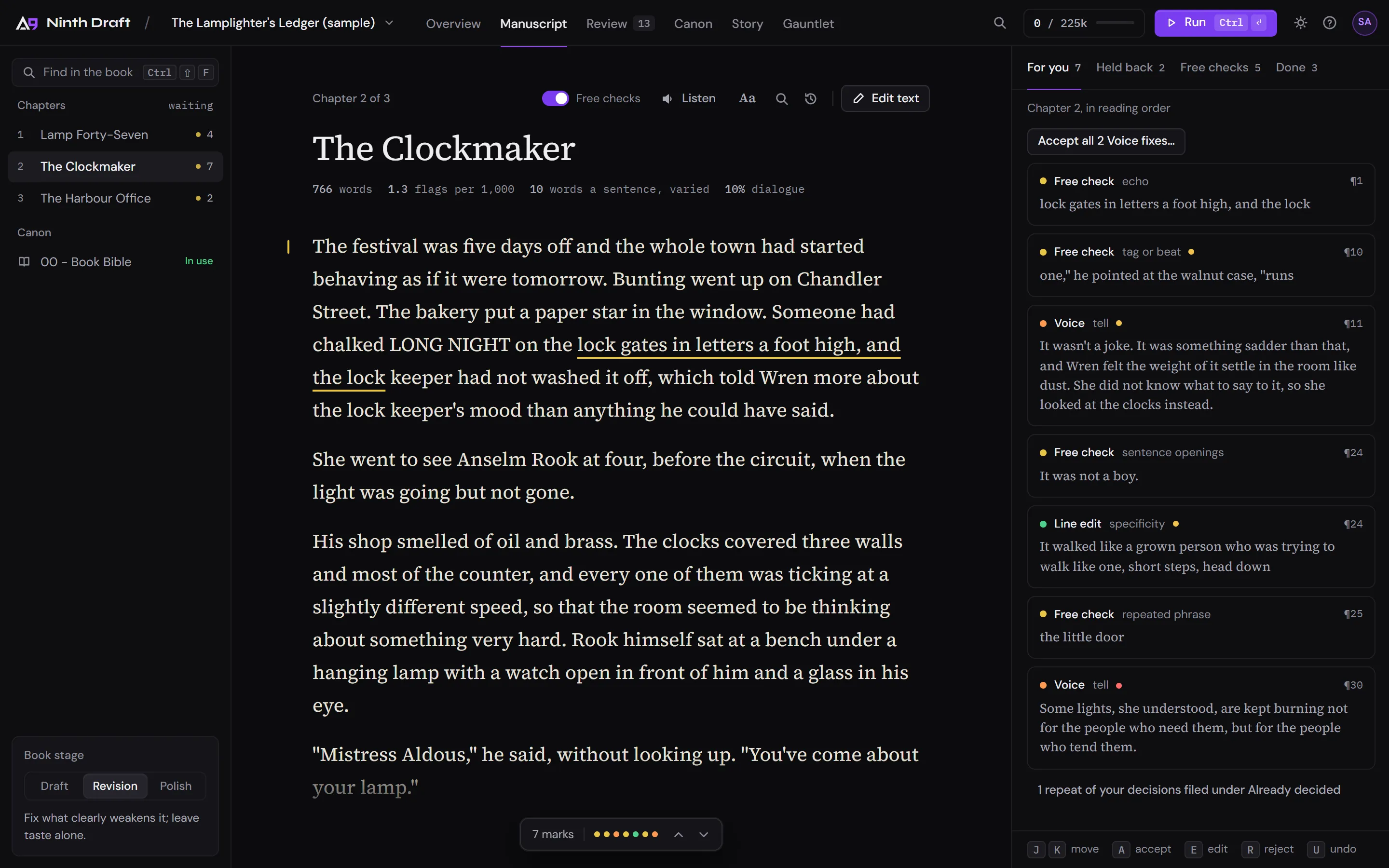
Chapter 2 of our sample novel, with the suggestions from that run and the free checks. Click a highlight or a card. Accept changes the text, Reject leaves it alone, and Run replays the run with the passes you tick.
2. The Clockmaker
The festival was six days off and the whole town had started behaving as if it were tomorrow. Bunting went up on Chandler Street. The bakery put a paper star in the window. Someone had chalked LONG NIGHT on the lock gates in letters a foot high, and the lock keeper had not washed it off, which told Wren more about the lock keeper's mood than anything he could have said.
She went to see Anselm Rook at four, before the circuit, when the light was going but not gone.
His shop smelled of oil and brass. The clocks covered three walls and most of the counter, and every one of them was ticking at a slightly different speed, so that the room seemed to be thinking about something very hard. Rook himself sat at a bench under a hanging lamp with a watch open in front of him and a glass in his eye.
"Mistress Aldous," he said, without looking up. "You've come about your lamp."
"I have."
"It goes out." He set down his tweezers. "I see it from here. Every night this week. I thought the oil was bad."
"The oil is fine."
"Then I don't know what to tell you." He took the glass out of his eye and looked at her properly, and he was older than she remembered, and more tired. "I close at seven. I put the lamps out in here, and I go up to bed. I don't watch the street."
"Your clocks say different times."
"They always have. That one," he pointed at the walnut case, "runs four minutes fast. I keep it that way so I'm never late for anything. It hasn't helped."
It wasn't a joke. It was something sadder than that, and Wren felt the weight of it settle in the room like dust. She did not know what to say to it, so she looked at the clocks instead.
There was a kind of quiet in the shop beneath all the ticking, a stillness that came from a man who had lived alone among his work for a long time. She understood it. She had a lamp house.
"Did anyone come by last night," she asked. "Around seven."
Rook thought about it. "A boy. Selling matches, or pretending to. He stood at your lamp a while. I thought he was warming his hands."
"What did he look like?"
"Like every boy. Cap. Thin. He had a cough." Rook picked up the tweezers again. "I'm sorry. I'm not much of a witness. I spend my days looking at very small things."
Wren thanked him and went out. Tobin was waiting on the bridge with the cart and the ledger, stamping his feet.
"Well?"
"A boy with a cough."
"That's half the town." He thought about it. "I reckon it's the Feeney twins. They took the brass handles off the lock house last winter."
"Then we'll see if they come back."
They did the circuit fast, faster than they ought to have, and Wren lit Lamp 47 at six exactly and wrote it in the ledger herself. Then, instead of going on, she pushed the cart into the dark under the bridge arch on the east side and sat down on the cold stone step where she could see the lamp and the clockmaker's door both at once.
Tobin sat beside her. For once he did not talk. Their breath went up white.
At ten to seven the light in Rook's shop went out. At four minutes to seven a figure came along the bridge from the town side. It was not a boy. It walked like a grown person who was trying to walk like one, short steps, head down, and it wore a long coat that was too big for it.
It stopped under Lamp 47. It looked both ways along the bridge. Then it reached up, opened the little door with a gloved hand, and pinched the flame out.
Tobin grabbed her sleeve. Wren was already standing.
"Hoy," she said, not loud.
The figure turned, and ran, and was gone into the lanes behind the chandlery before she had taken three steps. The the lamp ticked as the glass cooled. Somewhere behind her, in the dark shop, a clock that ran four minutes fast began to strike seven.
Wren walked back to the lamp and relit it. Her hands were not quite steady, and she was surprised by that.
Some lights, she understood, are kept burning not for the people who need them, but for the people who tend them.
Real output from one run on our sample novel, The Lamplighter's Ledger, with all four passes on. Every new account's sample book opens with this run. At the Revision stage Line edit starts off, so tick it to include it when you replay. In the app, it's your book.
Your canon comes first.
Every book has rules: who your characters are and how they talk, what day it is in chapter twelve, the words your narrator never uses. Ninth Draft starts from your own story bible, continuity notes and editor's notes, and checks the book against them. Bring yours on the Canon page as a Word, PDF, Markdown or text file, or paste the text in; adding it uses no words. New to bibles? Read what goes in a story bible, and how to write one.
No bible yet? It drafts one from the manuscript, with premise, point of view, voice, characters, timeline and locked facts, for you to correct. On a 250,000-word manuscript, the draft took under four minutes.
Free checks run in your browser on every chapter: repetition, dialogue and typography, a word written two ways, who's on the page. Spelling and style signals are there too, off until you turn them on. Each plan reads up to a set length of canon with every pass: 15,000 words on the free trial, 40,000 on Per book and Writer, 80,000 on Pro.
Wren Aldous: 52. Lamplighter for 31 years. Left-handed; lights lamps with her left hand and carries the pole on her right shoulder.
Tobin Vey: her apprentice, 14. Says “reckon”: no more than twice a chapter, and only Tobin says it.
Voice. Never use “suddenly” in narration. No thesis sentences.
Rules a pattern can check become house rules. No AI and no words: they run every time you open a chapter.
Passes with one job each.
Run the passes you need, on a chapter or the whole book. Each step you tick has its own words, because each reads your chapters with your canon and its own instructions: Proof uses about a hundredth of the words it reads, Continuity about two thirds, Voice about a quarter (half as an early draft), Line edit about a fifth (a third as an early draft), and the second check about a quarter (nearly half as an early draft, less on a polished book). Untick a step you don't need and the run uses fewer. Today a full run of a 100,000-word novel uses about 109,000 words at Revision, about 155,000 as an early draft and about 78,000 at Polish, with each stage's usual steps, and the estimate shows the real number, each step's words beside its box, before anything runs.
- Proof
- Typos, doubled words, punctuation, a name spelled wrong. Never style.
- Continuity
- Names, ages, the story clock, who knows what and when, objects that move, against your bible and the rest of the book. The slips it looks for are in our guide to continuity errors in a novel.
- Voice
- Your own voice rules first, then the tells AI-assisted prose leaves behind.
- Line edit
- A handful of the weakest passages, rewritten in your voice. Not a rewrite of the chapter.
- Story
- A read of the whole book from its chapter summaries and your canon: structure, pacing, promise and payoff. On every plan.
- Free checks
- Repetition, dialogue and typography, in your browser. No AI, no words.
The gate says no.
An independent second check, which never wrote the edits it judges, reads every suggested edit against your canon and the chapter, and holds back edits that add facts, contradict the canon, flatten the voice or are only taste. Questions skip it and come straight to you. Nothing it holds back is hidden.
| Pass | Suggested edit | The gate |
|---|---|---|
| Continuity | The festival was five days off and the whole town had started behaving as if it were tomorrow. | Passed. |
| Voice | Wren did not know what to say to that, so she looked at the clocks instead. | Passed. |
| Line edit | He said it lightly, and it was not a joke. Wren listened to the walnut case tick along its four minutes ahead of the others and found nothing to say. She looked at her boots, then at the clocks. | Held back. Wordier than the original, keeps the 'not a joke' framing and adds invented business; the simpler trim does the job. |
| Voice | Beneath all the ticking the shop was quiet. She understood it. She had a lamp house. | Passed. |
| Line edit | Under the ticking there was a quiet she knew, the quiet of a room where one person has kept the same hours for years. | Held back. Slips into present tense ('has kept') and makes the next line, 'She understood it', redundant. |
| Line edit | It walked like a grown person trying to pass for a boy: short steps, head down | Passed. |
| Proof | The lamp ticked as the glass cooled. | Passed. |
| Voice | Passed. | |
| Line edit | She took the ledger from the cart and, in the notes column beside 47, wrote one word with her left hand: snuffed. | Held back. Invents a new action (writing 'snuffed' in the ledger) that the chapter doesn't contain; plain deletion is the better fix. |
The gate is an AI check too, so it can miss, and you still decide. What it holds back stays readable under Held back, and you can accept it if you disagree. On a polished 250,000-word novel it held back 124 of 144 generic voice “fixes”, mostly as the author's deliberate style or plain taste.
You decide. All of it is reversible.
Every suggestion quotes the exact text it would change; if the quote isn't in your chapter word for word, it's dropped before you see it. Reject one and say why, and Ninth Draft remembers: a repeat is filed under Already decided instead of asking again.
The narrator explains where the stillness comes from (a man alone a long time), which the reader already infers. 'She had a lamp house' is a good deadpan beat and survives the trim.
Gate passed. Trims an explanatory caption while keeping the deadpan lamp house beat and its implication.
The sample's author rejected this one as wrong, and said why: The explanation is Wren recognising herself in him; it stays.
Every later pass reads that, and won't repeat it without new evidence.
Change a passage you decided on, and Ninth Draft asks: still what you want?
Accept, edit or reject each suggestion. Undo any accept. Restore any earlier version of any chapter from History.
Book stages set how hard it pushes.
Tell Ninth Draft where the book is, and the passes and the gate adjust, from a hard edit to a light touch.
Early draft
Hard edit: every pass, line edits on.
Revision
Fix what clearly weakens it; leave taste alone. Line edits off by default.
Polish
Near final: errors, broken rules, contradictions only. Voice and Line edit off by default.
On the three noisiest chapters of that 250,000-word novel, switching to Polish took Voice and Line edit from 35 proposals, none worth showing, to one.
What's sent, and when.
Nothing leaves until you start a run. You can export or delete your books whenever you like. The rest is on our trust page.
Sent only when you press Run
the chapters you run, your canon, your decisions and short summaries of your other chapters, to our AI provider. Each summary is made by sending that chapter once, and again when it changes.
Never used to train AI
Not by us, and not by our AI provider, whose commercial terms forbid training models on what we send.
In and out.
In
- Word (.docx)
- Markdown
- Plain text
You see the chapters a file will make, with titles and word counts, before a book is created.
Out
- Word manuscript, clean or with tracked changes
- A Word file for Vellum or Atticus
- An EPUB for each store
- A paperback interior for KDP
- The book as one Markdown file
Every export works on every plan, whether or not you're paying. Every EPUB is validated in our tests, and a check before you download lists anything to look at.
Ready for readers.
Front and back matter
Title page, copyright page with checked ISBNs, dedication, also by and about the author, written once and placed in order in the Word file and each store's EPUB.
Querying
Your query, synopsis, blurb and bio counted against the usual ranges, standard manuscript format and partials, and a private log of what you sent. It never sends anything for you.
Beta readers
A private link for each reader to the chapters you choose. Their comments wait in Review as questions, never edits, and are never sent to the AI.
Reading it back.
Read aloud
A chapter or a suggestion, a sentence at a time, in your device's own voices. An online voice sends your text to your browser's voice service, so it's used only if you choose it.
Progress
A goal with a date, your rhythm counted by the week and never as a daily streak, and every Continuity finding in one ledger beside your timeline. No AI, no words.
The Gauntlet
Give it an old draft of a chapter and the revision you were happy with. Ninth Draft revises the old draft on its own, and a judge compares the two in both orders, so position can't decide it. It uses words, like any run.
The app today
Screens from a new account.
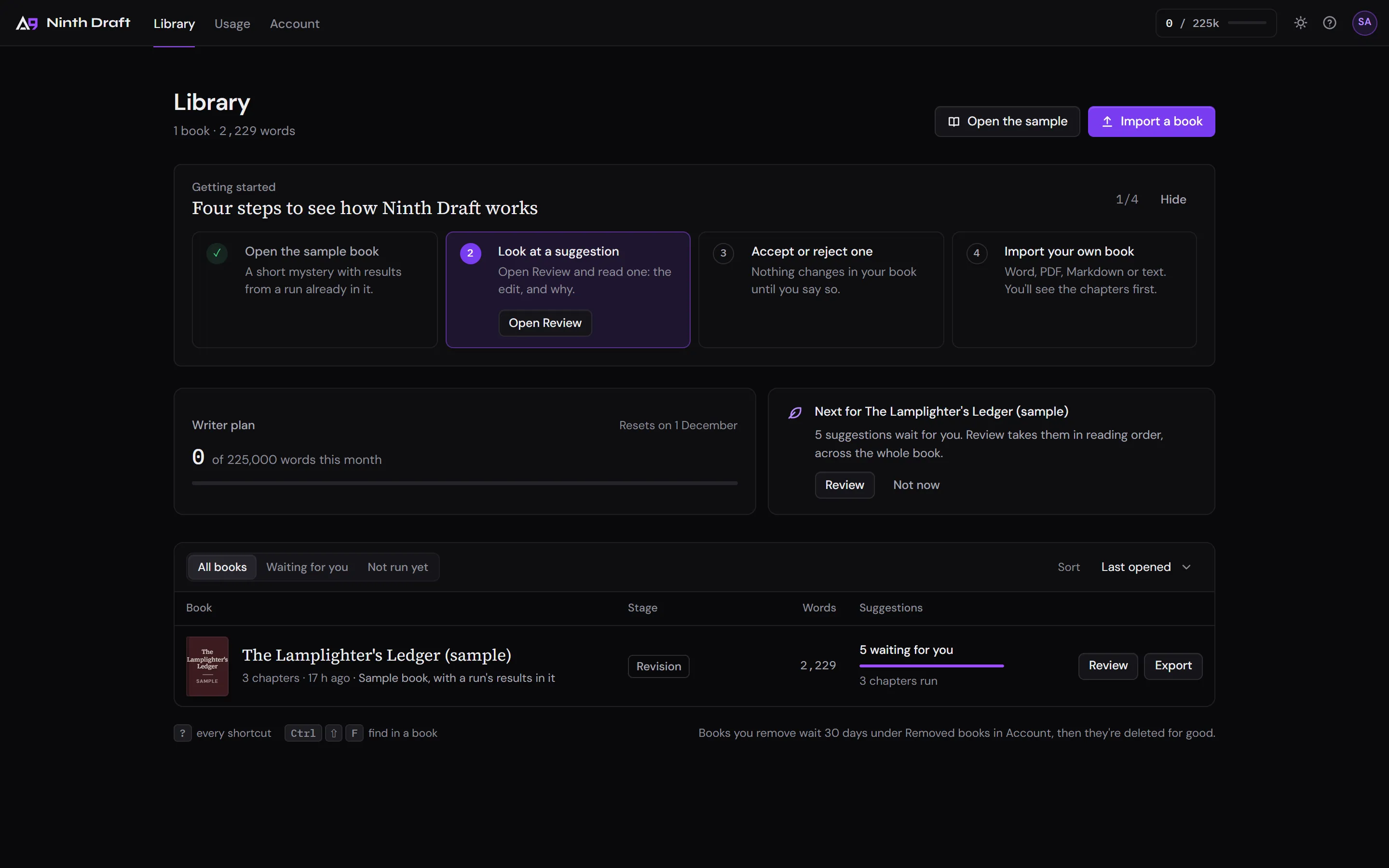
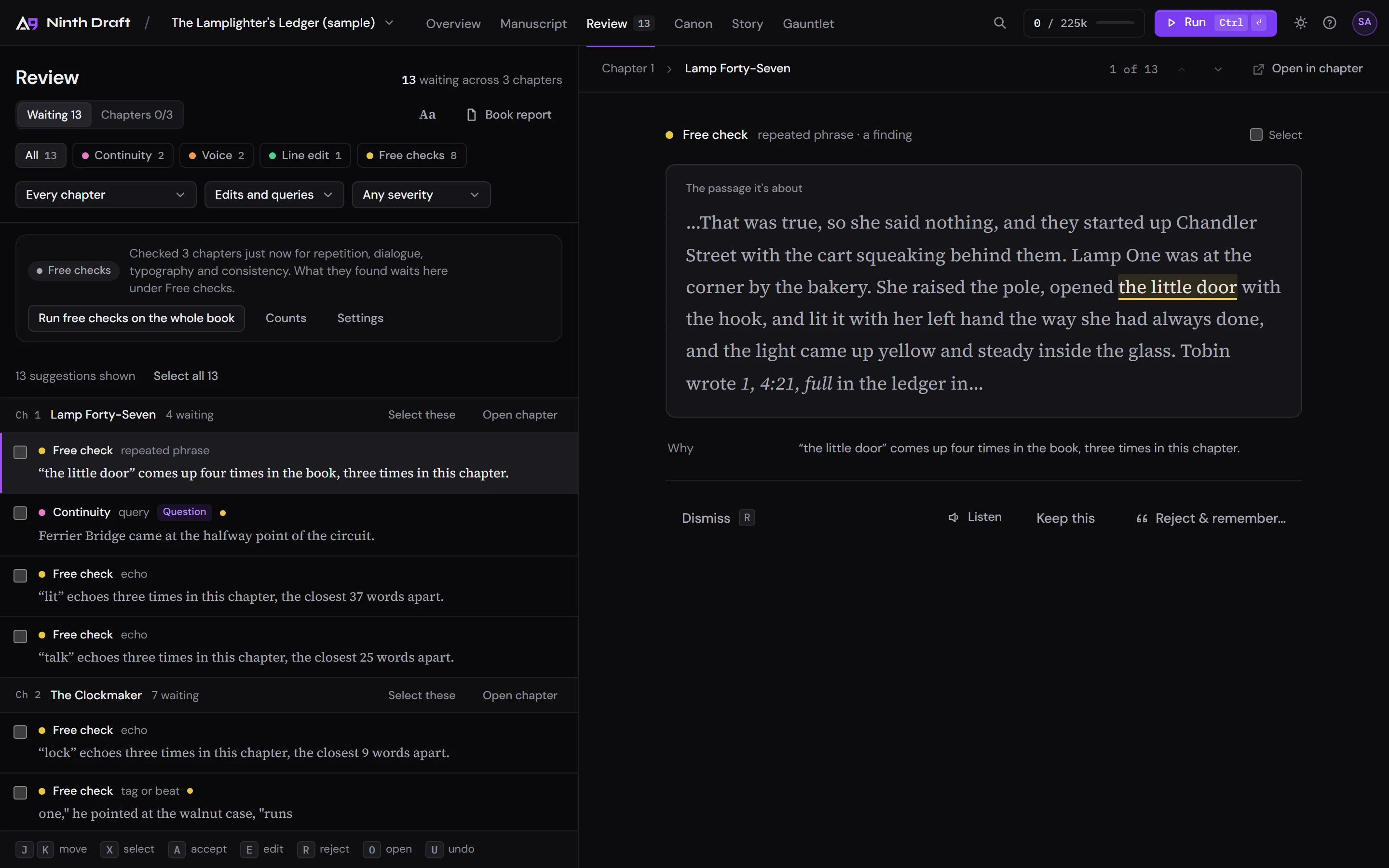
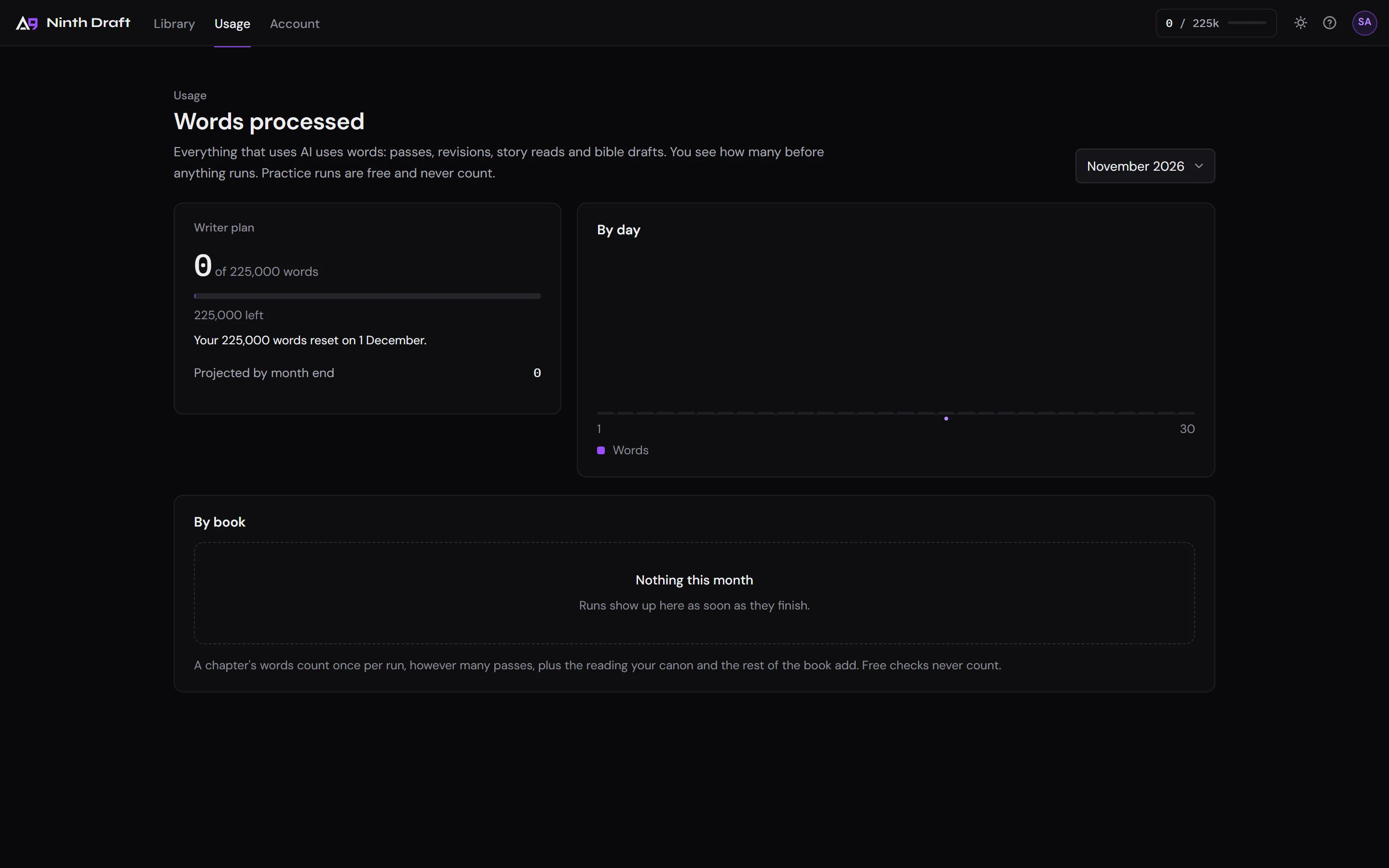
A new Writer account with the sample book, captured from the app as it is now.
See it on your own chapters.
We're letting authors in a few at a time. Beta testers don't pay.